Skip to main content
Gaming Desktop vs. Console: What Should You Choose?
6/12/2026
If you've ever gone down a rabbit hole trying to figure out whether a gaming PC or a console is the right move, you already know how quickly things get complicated. Frame rates, upgrade costs, couch co-op, keyboard shortcuts, it all blurs together fast, but for most players, it's really a lifestyle decision.
A console gives you fixed hardware, a familiar setup flow, and a more standardized experience. A gaming desktop gives you a much wider range of hardware choices, more room to tune settings, and more ways to expand your setup over time. These factors are why the smarter personal computer (PC) vs. console question isn’t “Which is better?” but “Which feels right for the way I play?”
PC vs. Console Gaming: What’s the Difference?
At a high level, the difference between PC and console gaming comes down to flexibility vs simplicity.
- Gaming desktops are built for customization. You can adjust settings, upgrade parts, and fine-tune how games run. This often leads to smoother visuals and quick load times.
- Consoles are built for consistency. Every system runs the same hardware, so games are optimized to work right out of the box. You set it up, turn it on, and start playing, no extra steps required.
What to Consider When Choosing Between a Gaming Desktop vs. Console
To make a confident choice between a gaming desktop and a console, focus on the factors that matter in real-world use. Performance, game libraries, setup requirements, long-term flexibility, and even where you plan to play all play a role in shaping your experience.
Performance
Modern consoles focus on fast load times, smooth motion, and reliable performance. Features like solid-state drive (SSD) storage and support for higher frame rates mean less waiting and more fluid gameplay. Gaming desktops take things further by offering range. Depending on your setup, you can adjust graphics settings, target higher frame rates, or fine-tune performance for the games you play most.
In everyday terms, the flexibility of a gaming desktop can potentially mean:
- Smoother visuals in fast-paced games
- Sharper image quality
- More control over how games run on your system
These don’t automatically make PC gaming “better,” but it does give you more ways to shape the experience.
Game Access and Libraries
Another major part of comparing PC and console gaming is how you access games.
Console gaming takes a more curated approach:
- Dedicated storefronts tied to each platform
- Subscription services that offer rotating game libraries (great for discovery)
- Strong exclusive titles you can only play on that specific system
PC gaming opens a wider range of options:
- Multiple storefronts like Steam, Epic Games Store, and GOG.com
- A massive catalog of indie titles, older classics, and niche genres
- Modification, or mod, support that can extend the life of your favorite games for years
If you like variety, want to revisit older favorites, or love diving into community-built content, the PC library gives you plenty of room to roam.
Setup
Consoles are designed to be simple. Plug it into your TV. Connect to the internet. Start playing. That ease makes them a natural fit for shared spaces like living rooms.
Gaming desktops require more setups. You may need to install updates, adjust settings, and manage storage. But that extra effort comes with added versatility. You can use a desktop for gaming, work, streaming, and more.
Upgrades and Long-Term Use
The way each system evolves over time is another key difference between the two platforms.
With a console:
- Software updates improve features and stability over time
- Hardware stays fixed until the next console generation or model refresh
- Major performance upgrades usually mean buying a new system
With a gaming desktop:
- You can swap out individual components—graphics cards, random-access memory (RAM), storage—as needed
- Upgrades happen on your timeline, not a manufacturer's release cycle
- You don't have to start from scratch to stay current
For players who want to stay competitive without replacing everything every few years, the modular nature of a desktop can make a real difference in the long run.
Cost Range (Upfront vs Long-Term Value)
Consoles typically have a lower upfront cost. You buy the system, a controller, and maybe a subscription for online play. It’s predictable and easier to budget at the start.
Gaming desktops can vary widely in price. Entry-level PCs may be comparable to consoles, while high-performance builds can cost significantly more. However:
- PCs can be upgraded instead of replaced
- You’re investing in a multi-use device
The key difference is how you think about value. Consoles are more straightforward upfront, while PCs can offer long-term flexibility if you plan to upgrade over time.
Home Layout
Where your system lives in your home can influence your choice more than you might expect. Consoles fit naturally into shared spaces with a TV, while gaming desktops are better suited for desk setups or dedicated areas.
If gaming is something you do casually or socially, a console can feel more natural for shared or casual play. Alternatively, a desktop setup may be better for focused or individual gaming.
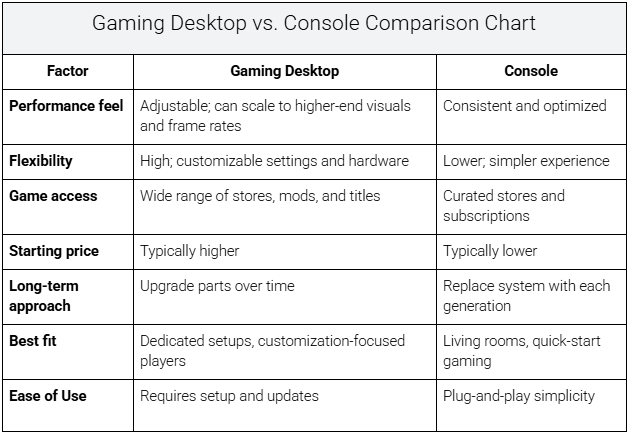
Here’s a quick snapshot of how desktop and console gaming compare, based on information from HP:
PC vs. Console: Which Should You Choose
The best way to decide between computer and console gaming is to think about how gaming fits into your life.
A console might be right for you if:
- You want a simple, plug-and-play experience
- You enjoy gaming on a TV with friends or family
- You prefer minimal setup and maintenance
- Gaming is more casual or social
A gaming desktop might fit better if you:
- Want top-tier performance or customization
- Play competitive or graphics-heavy games
- Like upgrading and personalizing your setup
- Need a device for gaming, work, and more
In other words, the best choice is the one that aligns with your habits, your space, and how hands-on you want to be.
Make Your Move with Acima Leasing
Once you’ve narrowed down what matters most—performance, simplicity, or flexibility—the next step is choosing a setup that fits your schedule as comfortably as it fits your lifestyle. Whether you lean toward console or PC gaming, Acima Leasing can give you flexibility when it's time to choose.
Consoles and computers with lease-to-own options mean you don't always have to wait to get the gaming setup you need. You can find an Acima Leasing partner near you, browse gaming setups online, or download the app to get started.